The Overhead Door Is the Loading Dock Bottleneck Nobody Budgets For
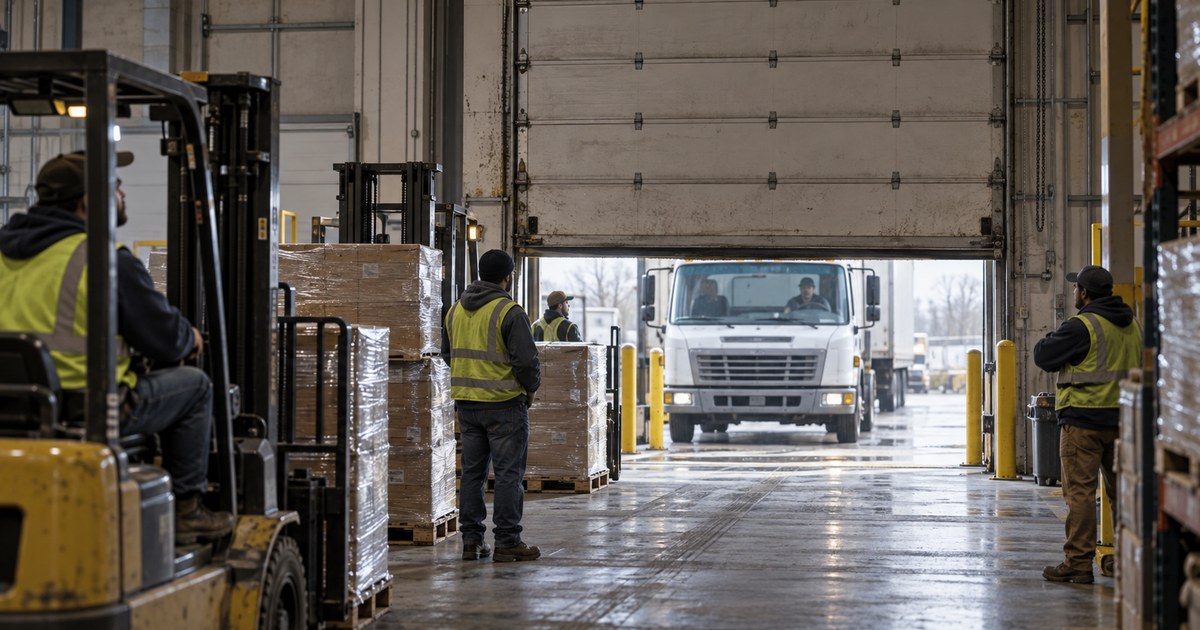
Ask an operations manager to name the equipment that can stop a shift and the answers come fast. The forklift. The compressor. The dock leveler. The overhead door almost never makes that list, right up until the morning it will not open and a full outbound schedule sits on the floor while somebody calls around looking for a technician who can come today.
Commercial door failure is unusual among maintenance problems because the direct cost is rarely the real cost. The part that broke is often inexpensive. A torsion spring, a worn set of rollers, a photo eye knocked out of alignment by a pallet jack. The repair invoice is not the story. The story is the four hours the bay was unusable, the drivers who idled, the delivery window that slipped, and the customer who noticed it slipped.
Why commercial doors fail differently than residential ones
A residential garage door cycles maybe four to six times a day. A commercial roll-up on an active dock can cycle fifty times before lunch. Cycle count, not age, is what wears a door out, which is why a five-year-old commercial door can be in worse mechanical condition than a fifteen-year-old door on a house.
That changes what preventive maintenance has to look like. On a residential door, an annual inspection is reasonable. On a high-cycle commercial door, an annual inspection means the springs are being checked once every twelve to fifteen thousand cycles, which is well past the point where fatigue starts showing up in the wire. Operations that run doors hard and inspect them on a homeowner's schedule are effectively running to failure and calling it maintenance.
The failure modes that actually cause downtime
Three patterns account for most emergency commercial door calls.
Spring fatigue. Torsion springs are rated in cycles, and they fail without much warning. When one goes on a commercial door, the door becomes both immovable and dangerous, because the counterbalance that made a several-hundred-pound door manageable is gone. This is not a repair for in-house maintenance staff, whatever the internet suggests.
Track and roller wear. Rollers that have flattened or seized drag the door out of square. The door still works, just harder, and the opener starts pulling more current than it was sized for. Left alone, a roller problem becomes an opener problem, and an opener is an order of magnitude more expensive than a set of rollers.
Safety system drift. Photo eyes get bumped. Auto-reverse pressure settings drift as the door's balance changes. On a commercial door this is a genuine safety exposure, not just an inconvenience, and it is the sort of thing an insurance adjuster asks about after an incident.
Budgeting for the door before it budgets for you
The businesses that avoid emergency door calls tend to do three unglamorous things. They know their cycle count, or at least estimate it honestly. They scale inspection frequency to that count rather than to the calendar. And they build a relationship with a door contractor before there is an emergency, so the first conversation is not happening at seven in the morning with a truck waiting.
That last one matters more than it sounds. Emergency commercial door work gets triaged by whoever is already on a contractor's books. A business that has never called before is competing for the same slot as a business that has a maintenance agreement, and it usually loses.
For operations across eastern Indiana and western Ohio, PJ's Doors commercial door solutions covers roll-up, high-speed, and fire-rated systems, with every visit including a twenty-seven point inspection that documents condition rather than just addressing the complaint that prompted the call.
The calculation worth running
Take an honest number for what one hour of a blocked bay costs the business. Multiply it by four, which is a realistic figure for locating a contractor, getting them on site, and completing an unscheduled repair. Compare that against the annual cost of scheduled inspections on the same door.
For most operations running a door at commercial cycle rates, the comparison is not close. The inspection program pays for itself the first time it catches a spring before the spring catches the schedule.